$100.00
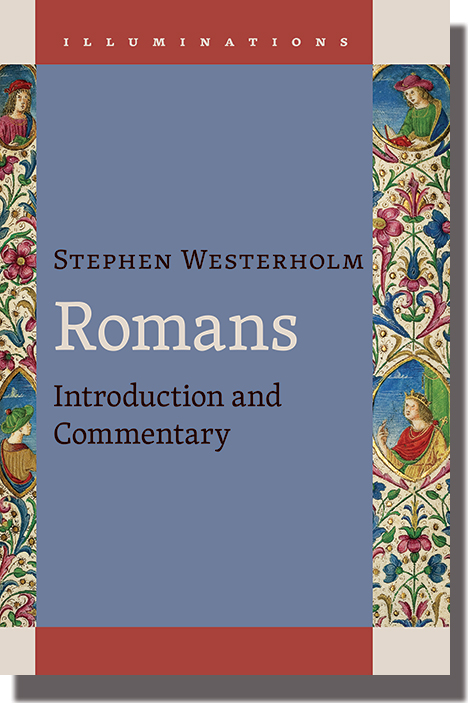
No work has shaped Christian thought more profoundly than Paul’s Letter to the Romans, yet contemporary audiences often struggle to understand Paul in his first-century context. In this commentary on Romans, Stephen Westerholm provides a fresh translation of the ancient texts, an accessible interpretation that will appeal to a broad audience, and a verse-by-verse commentary covering key phrases and words that sharpen readers’ understanding of the text’s complexity. This essential resource familiarizes scholars, students, and pastors with not only Paul’s thought and its continuing relevance but also the history of the letter’s influence on literature, music, and hymnology.
Stephen Westerholm taught New Testament and Early Christianity at McMaster University from 1984 until his retirement as Professor Emeritus in 2017. He holds a ThD from Lund University in Sweden. His major publications include Perspectives Old and New on Paul: The “Lutheran” Paul and His Critics (2004), Reading Sacred Scripture: Voices from the History of Biblical Interpretation (with Martin Westerholm; 2016), Law and Ethics in Early Judaism and the New Testament (2017), and Romans: Text, Readers, and the History of Interpretation (2022). He is the editor of The Blackwell Companion to Paul (2011).
Praise for Romans: Introduction and Commentary
“Stephen Westerholm has labored long and hard in the Pauline vineyard, and all of his works on Paul show depth of analysis, helpful exegesis, and a refusal to ignore the more difficult aspects of Pauline theology and ethics. This Illuminations commentary is no exception. Especially helpful is his treatment of God’s righteousness and righteous wrath, its relationship to the death of Jesus, and its bearing on the right standing and righteousness God graciously offers us all. There is a lifetime of pondering Paul reflected in this book, and it is well worth our close inspection.”
“Westerholm’s Romans commentary in the Illuminations series does more than explain Paul’s letter in its historical and literary context. A distinctive strength of the volume is its attention to Retrospect and the History of Consequences—the ways Romans has been interpreted, appropriated, and experienced across time. This is a much-needed dimension in a field where commentaries too often give insufficient attention to the history of interpretation and reception.
Westerholm invites readers to consider not only what Romans may have meant within its historical context, but also what it has come to mean through centuries of theological reflection, ecclesial use, social practice, controversy, and, at times, harmful consequences. This volume treats interpretation as an ongoing historical conversation and asks readers to reckon seriously with both the constructive and troubling legacies of Romans as they consider its significance for a world—such as today—marked by conflict, division, and profound social upheaval.
This volume deserves a place in theological libraries and personal commentary collections alike. It will be especially valuable for students at every level who are learning not only how to interpret Romans, but also how to engage responsibly with the long and consequential history of its interpretation.
“‘No one verily can read it too oft or study it too well,’ wrote Tyndale of the Epistle to the Romans. Stephen Westerholm’s new exposition reflects decades of such reading and study. Alongside his own translation, commentary, and retrospections, he brings together the voices of patristic writers, majority-world theologians, poets, and musicians from across the centuries. Learned without being ponderous, wide-ranging without losing its focus, this is a wise and judicious companion to Romans, and it is a book to which teachers and preachers will return again and again.”
Request a review copy.